
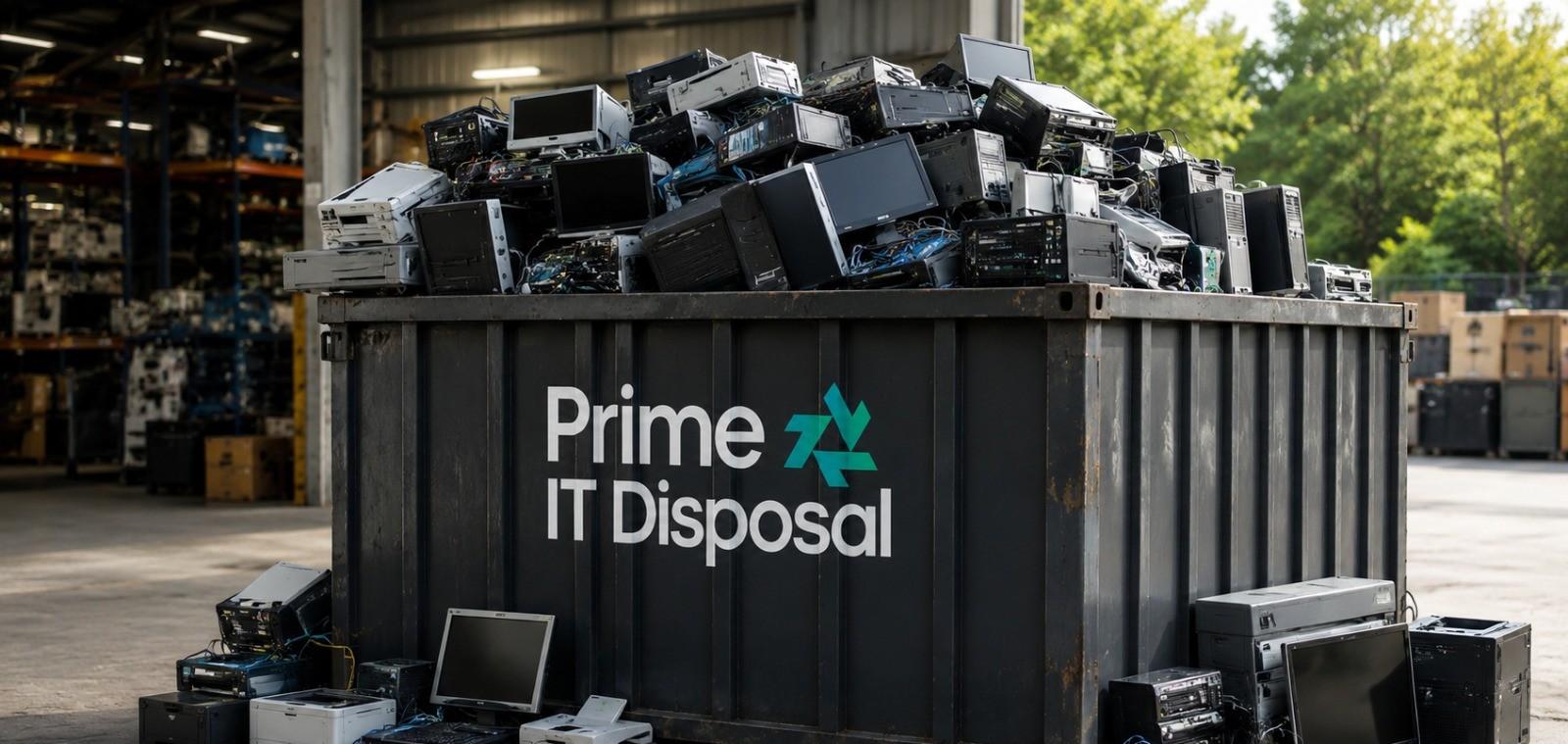
Most businesses encounter WEEE compliance the same way: someone asks for the waste transfer note during an audit or a tender, and nobody can find one.
The rules themselves are not complicated. What catches organisations out is a single principle — the legal responsibility for your waste does not transfer to whoever takes it away.
What WEEE covers
WEEE stands for Waste Electrical and Electronic Equipment. In practice, if a piece of equipment needs mains power or a battery to do its job, it is almost certainly WEEE when you dispose of it.
For a typical business that means:
- Computers, laptops, tablets, monitors and peripherals
- Servers, switches, routers, firewalls and rack equipment
- Printers, copiers, scanners and multifunction devices
- Phones, handsets, headsets and mobile devices
- Batteries, UPS units and power supplies — which carry additional hazardous waste requirements
Equipment disposed of by a business is classified as business WEEE, and it may not be sent to landfill or put into general waste.
Duty of care: the obligation that does not transfer
Under section 34 of the Environmental Protection Act 1990, anyone who produces, holds or disposes of controlled waste has a duty of care over it. For a business disposing of IT equipment, that duty has three practical parts.
- 1Check that whoever takes your waste is authorised to do so — meaning a registered waste carrier, whose registration you have actually verified rather than assumed.
- 2Ensure the waste is transferred with an accurate written description of what it is.
- 3Keep the waste transfer documentation, and be able to produce it on request.
Waste carrier registrations are public. You can check any carrier's licence number on the Environment Agency's public register — and any provider unwilling to give you their number has answered a different question than the one you asked.
The documents you should be keeping
Three documents matter, and between them they should account for everything that left your site:
- Waste transfer note — issued for each collection, describing what was transferred, when, between whom, and under which waste codes. Duty of care requires these to be retained for at least two years.
- Hazardous waste consignment note — required where a regulated fraction is involved, such as batteries, certain lamps or CRT displays. These must be retained for at least three years.
- Itemised asset register — not a legal requirement under WEEE, but the document that makes the other two useful, because it ties the collection to specific serial numbers you can reconcile against your own inventory.
Where data protection and WEEE overlap
WEEE governs the environmental handling of the equipment. UK GDPR governs the data on it. Both apply simultaneously to the same laptop, and they are enforced by different regulators with different powers.
This is why disposal paperwork comes in pairs. A waste transfer note that shows equipment was handled compliantly says nothing about whether the data was destroyed. A destruction certificate that shows the data was destroyed says nothing about where the plastics and metals ended up. You need both, and they should arrive together.
What 'zero to landfill' should mean
The phrase is used loosely. Applied honestly it means the waste hierarchy is followed in order: equipment that still works is reused, equipment that does not is separated into clean material streams for recycling, and nothing is sent to landfill as mixed waste.
The way to test the claim is to ask for the numbers. A provider genuinely operating this way can tell you the weight collected, the proportion reused versus recycled, and the resulting outcome — figures you can put directly into your own environmental reporting. A provider who cannot produce those figures is describing an intention rather than a process.
Frequently asked questions
At least two years for standard waste transfer notes, and at least three years for hazardous waste consignment notes. Many organisations keep them longer to align with their own audit retention schedules.